Sourdough Hydration & Baker's Percentage Calculator
Enter how much dough you want and your percentages – get exact flour, water, salt and starter weights. Also shows the true hydration once the flour and water inside your starter are counted.
| Ingredient | Per loaf | Total |
|---|
True (overall) hydration: –
Reverse: what's the hydration of my dough?
Hydration ignoring starter: – · True hydration: –
How baker's percentages work
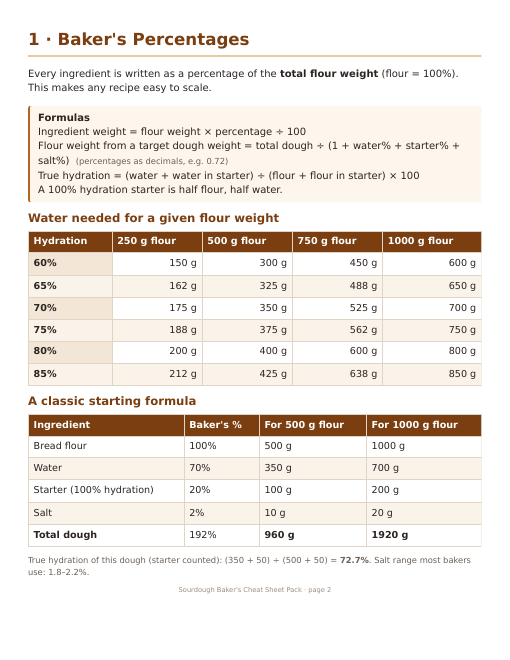
In baker's percentages every ingredient is expressed relative to the total flour, which is always 100%. A dough with 1000 g flour and 700 g water is 70% hydration; 20 g salt is 2%. This makes recipes easy to scale: change the total dough weight and every ingredient moves in proportion.
Why "true hydration" matters
Sourdough starter is itself flour and water. A 100% hydration starter is half flour, half water. If a recipe uses 200 g of starter, that adds 100 g flour and 100 g water, so the dough is wetter (or drier) than the headline water percentage suggests. This calculator treats your starter percentage as a share of the added flour, the convention most home recipes use, and then reports the overall hydration with the starter included.
Typical ranges
- Sandwich / tin loaf: 60–68% hydration
- Everyday sourdough boule: 68–75%
- Open-crumb / ciabatta style: 75–85%
- Whole wheat / wholemeal: often 5–10 points higher, as bran absorbs more water
- Salt: 1.8–2.2% is standard
FAQ
Does it work for yeasted bread?
Yes – set starter to 0% and add your yeast separately (about 1–2% fresh or 0.5–1% instant).
Can I use cups?
Volume measures vary too much for reliable hydration; a cheap kitchen scale gives far better results. Ounces are supported, and there is a grams to ounces baking chart if you need to convert a recipe.
Printable Sourdough Baker's Cheat Sheets – $1
A 7-page printable PDF to keep in the kitchen, so you don't need a screen with floury hands. You get it in both A4 and US Letter sizes.
- Baker's percentage formulas, a water-weight table (60–85% hydration for 250–1000 g flour) and a classic starting formula
- Hydration ranges by bread style, plus adjustments for bread, all-purpose, whole wheat, rye and spelt flour
- Starter feeding schedule: approximate time to peak for 1:1:1 to 1:10:10 feeds at about 20, 24 and 27 °C, plus fridge maintenance tips
- Bulk fermentation times by dough temperature (18–28 °C), final proof guide and a water-temperature formula
- Gram/ounce and °C/°F charts, plus common cup and teaspoon approximations
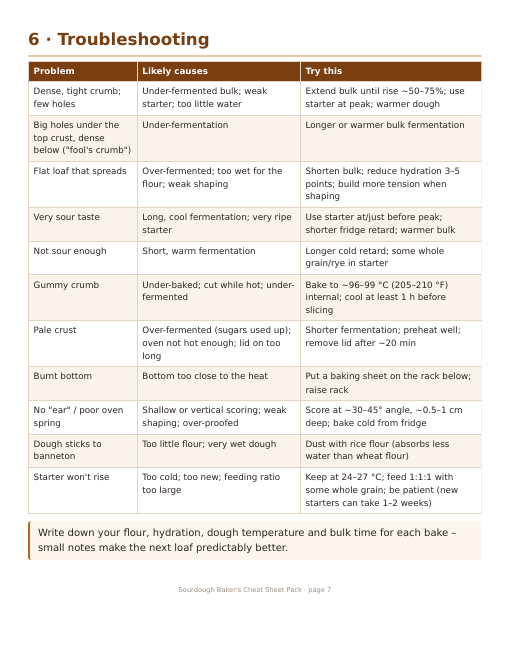
- Troubleshooting table: 11 common problems, their likely causes and what to try
Everything in the pack is general reference material. Fermentation times are approximate starting points, because starters, flours and kitchens vary. It's a digital download, so nothing is shipped. The calculator on this page stays free whether or not you buy.
Buy for $1 on PayhipSold on Payhip as "Sourdough Baker's Cheat Sheets (Printable)" for $1.00 USD. Payhip handles payment and delivers the files (one .zip with the A4 and US Letter PDFs) straight after purchase.
Support this tool
This calculator is free, has no ads and no sign-up. If it helped your bake and you'd like to chip in towards hosting and upkeep, you can leave an optional tip. It's entirely voluntary – the tool stays free either way.
☕ Buy me a coffee via PayPalPayments are handled by PayPal. Tips are not tax-deductible and don't unlock anything extra.
Privacy
The calculator runs entirely in your browser. No cookies, no analytics, no accounts – the numbers you type are never sent anywhere. Your last settings are saved only in your own browser's local storage. If you buy the printable cheat sheets, payment is handled by Payhip under Payhip's privacy policy, and optional tips go through PayPal; this site never sees your card details.